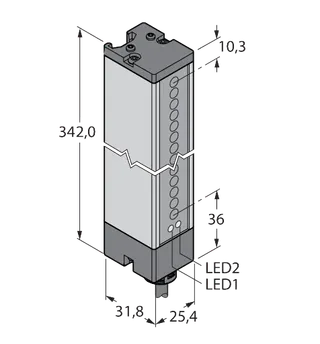
Optical Sensors
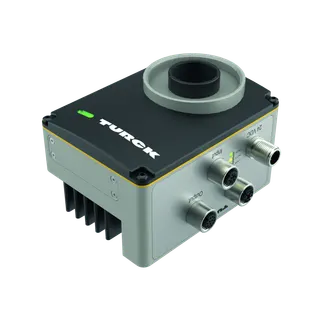
Optical sensors detect objects, edges, marks, or distances by emitting visible or infrared light and evaluating the reflected or interrupted beam. The assortment covers diffuse reflective sensors, retro-reflective sensors with polarisation filter, through-beam pairs, and camera-based vision units for AI-driven inspection. Typical use is in conveyor lines, packaging machines, handling robotics, and quality gates.
By measuring principle, the catalogue splits into diffuse types with ranges around 0 …450 mm, longer-range variants reaching 50 …450 mm, and short-distance miniatures down to 2 …450 mm or 3 …450 mm. Manufacturers with broad coverage include Turck and IPF.
Supply concepts are mostly DC/AC-wide. The dominant band starts at min. 10 VAC, with narrower DC variants at min. 12 V, min. 20 V, or min. 24 V, plus mains-level units from min. 90 VAC.
Switching frequency separates standard detection from fast counting tasks: typical values are 2.5 kHz, 5 kHz, and 10 kHz, with high-speed fork and fibre sensors reaching 1000 kHz or 2000 kHz.
Ambient ratings reflect the target environment. Indoor machinery dominates at -20 …+40 °C and -10 …+40 °C, cold-store and outdoor versions at -25 …+40 °C or -40 …+40 °C.
Pre-wired versions ship with cable lengths of 0.2 m, 2 m, [5 m](/en/optical-sensors?filters=%5B%7B%22key%22%3A%22EF000536%22%2C%22values