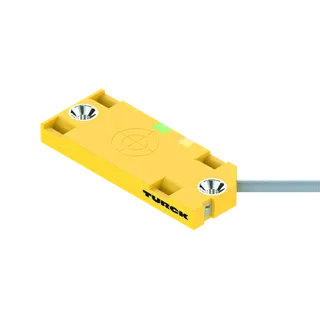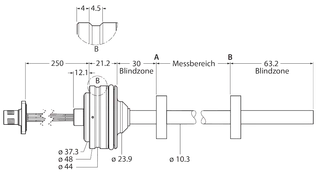
Capacitive Sensors
Capacitive sensors detect conductive and non-conductive targets through changes in the dielectric field at the active face. Typical use covers level monitoring of bulk solids and liquids, presence detection through container walls, and end-position sensing where inductive principles fail. Versions with potentiometer adjustment are common for fine-tuning the switching distance to the target medium.
The assortment is split between standard barrel-shape proximity types and dedicated level-limit switches, with Turck and IPF covering most SKUs. Output stages are mainly digital, with 1 digital output for single-threshold tasks and 2 digital outputs for window or NO/NC combinations.
Switching frequency dictates suitability for fast counting versus slow level tasks. The bulk of devices runs at 100 Hz, with slower variants at 50 Hz, 20 Hz and 10 Hz, plus high-speed types at 50 kHz and 100 kHz for object counting on conveyors.
Thermal ratings cover indoor cabinet use up to outdoor and process-near mounting. Most devices are rated -25 …+70 °C ambient, with extended ranges at -40 …+70 °C. For wetted-side limit switches, media ratings reach -25 …+100 °C and -40 …+100 °C.
Wiring is mostly 3-wire DC, with 4-wire versions for complementary outputs. Standard supply is 10–30 VDC, with narrow-range 20–30 VDC types for stabilized rails. Variants with potentiometer adjustment allow on-site calibration to specific bulk densities or container wall thicknesses.