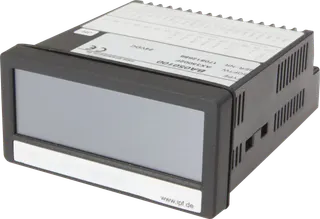
Sensor Evaluation
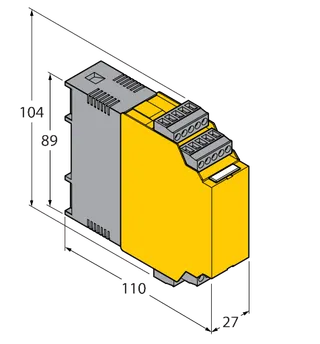
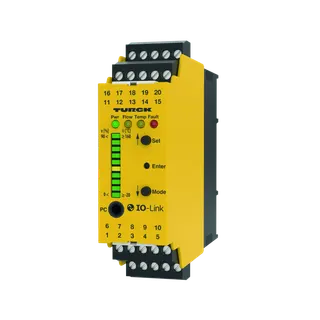
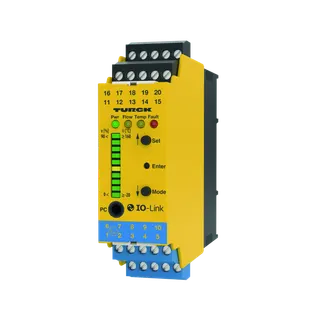
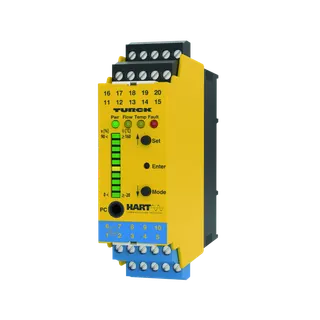
Sensor evaluation devices process raw sensor signals into switching outputs, analog values, or fieldbus telegrams for downstream control. Typical hardware includes signal converters, amplifiers, IO-Link masters, compact PLCs, current sensors, and safety I/O blocks. They sit between field sensors and the PLC in machine building, hydraulics, energy monitoring, and process automation.
The assortment covers manufacturers including Turck and in.hub, with recurring series such as IM12 isolating switching amplifiers, FI01 frequency interfaces, and IP67 compact controllers for direct field mounting.
AC-powered modules dominate the supply spectrum: most units run on 20…250 VAC, with wide-range variants from 12…250 VAC and 10…250 VAC. Switching outputs are rated up to 9 A, 12 A, or 16 A, suited to direct contactor or solenoid drive.
Ambient ratings cluster at -25…+70 °C for cabinet-mount evaluators and 0…+70 °C for indoor electronics, with extended versions down to -40…+70 °C. Switching frequencies span 40 Hz for relay outputs up to 5000 Hz on solid-state stages.
Special versions include EtherNet/IP block I/O with CIP Safety, IO-Link master ports, and CODESYS V3 PLCs with WebVisu licensing. Single-channel evaluators (1 channel) cover discrete amplifier tasks; dual-channel units (2 channels) handle redundant or paired sensor inputs. Pre-wired variants come with cable lengths of 3 m or 10 m.